
Workplace Training
FAQ and 5+ Top Providers to Consider
Workplace training has a place in any organization, no matter your industry, size, objectives, or culture. From onboarding to continued development, businesses and nonprofits alike can benefit from providing ongoing employee training.
Learning and knowledge accumulation start from employees’ very first days with your organization. Strong training programs provide employees with the skills and confidence they need to be productive, reliable members of your team, no matter where they are in their tenure with your organization.
When your organization provides in-house resources or outsources these responsibilities, this guide will provide strategies for improved workplace training, as well as top third-party providers who can help shape your approach to employee development.
Need new employee training resources and guidance?
ProspectHR has the tools and tips you need.
Frequently Asked Questions about Workplace Training
What is workplace training?
Workplace training refers to the educational programs that businesses and nonprofits offer their employees, supervisors, managers, and executives. It is one component of a broader professional development initiative.
Conceptually, workplace training touches upon all aspects of the work environment, from orientation programs that provide employees with general knowledge about the organization to courses that develop specific skill sets. In practice, the type of learning each organization focuses on depends on its resources and needs.
What are the benefits of workplace training for employers?
Some organizations hesitate to offer employee training out of fear that employees they invest in will then depart for other opportunities. However, the benefits of training for employers far outweigh this potential risk. They include:
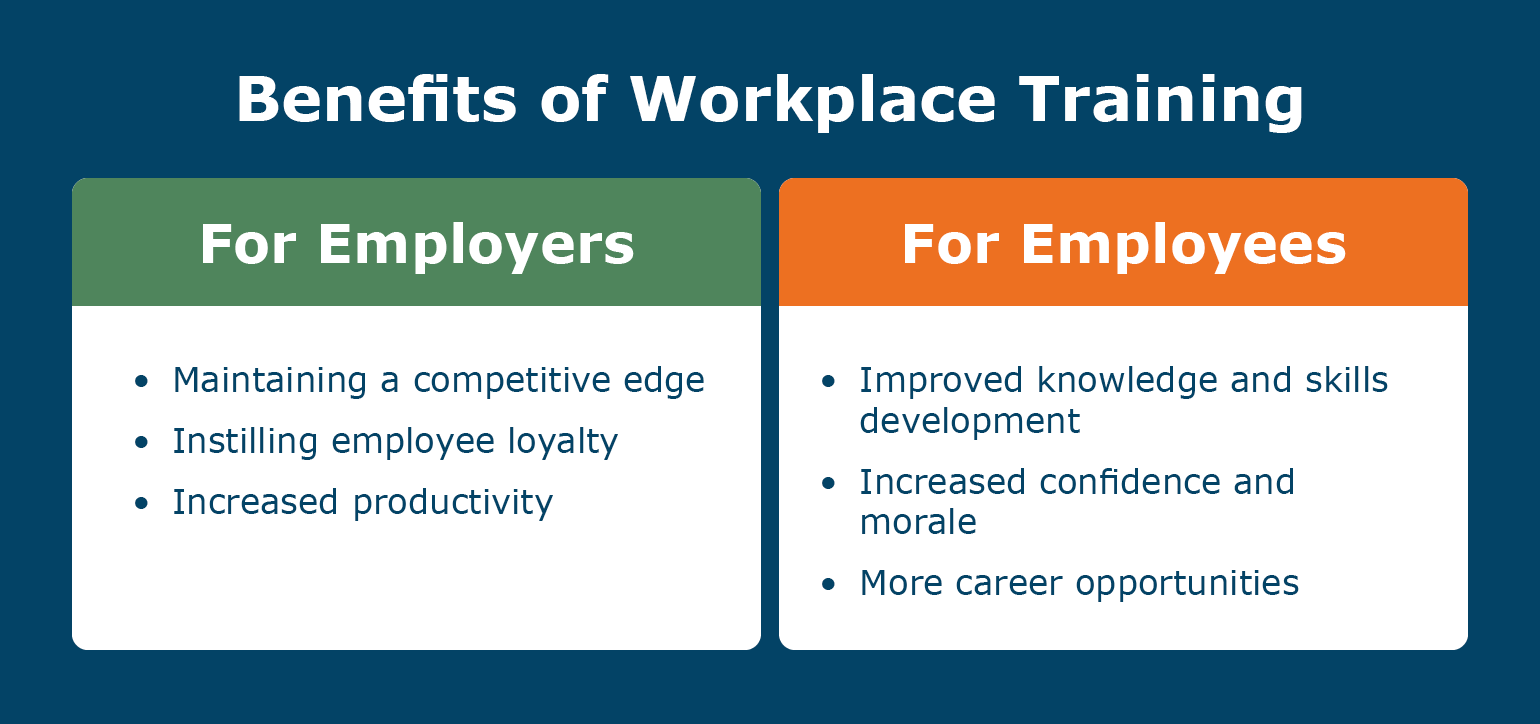
- Maintaining a competitive edge. In today’s marketplace, things move quickly, and change is a constant. It is imperative to keep employees up to speed in this ever-evolving environment if your organization is to remain competitive. In some instances, change directly impacts how workers perform their jobs—new techniques or technologies—while other advancements focus on the work environment, culture, or legal requirements—anti-harassment and safety courses that reduce injuries.
- Instilling employee loyalty. When your organization shows a commitment to employees’ career development, employees are more likely to feel a sense of loyalty in return, improving retention. Additionally, training improves your ability to promote internally, creating visible career paths that can inspire new employees.
- Increased productivity. A proficient staff provides greater efficiency and fewer mistakes. Skilled employees can do more, complete higher-quality work, and even share their knowledge with others, helping bring up the caliber of your entire team’s work.
What are the benefits of workplace training for employees?
Workplace training is a win-win for employers and employees. Specifically, employees who participate in training can enjoy:
- Improved knowledge and skills development. New skills and knowledge allow employees to complete their work more quickly, at a higher level of quality, and perform better in your work environment. With their increased knowledge, they are more likely to feel an investment in their daily tasks and may even find new strategies to improve your overall work processes. For example, a course on communication may reduce mistakes in team workflows, while an anti-harassment workshop may make employees feel psychologically safer.
- Increased confidence and morale. Professional development through training promotes confidence and know-how that may boost employee engagement and commitment to the organization. Employees will feel supported and confident that they have the tools they need to succeed.
- More career opportunities. Training opens doors for employees, both at your organization and elsewhere. You can take advantage of this by offering employees new roles and opportunities related to their newfound skills, such as the option to take on more complex projects, lead teams, or even recommend new projects. From there, employees will have the ability to advance internally at your organization, allowing you to have a pool of readily available, trusted candidates.
Types of Workplace Training
Some organization only train their employees on the bare essentials necessary to get the job done, while others cover numerous organizational initiatives and objectives. As your business or nonprofit grows, its training needs often evolve.
Training includes a broad range of topics, from legally required courses to professional development opportunities to basic new employee training. These each have different purpose and can bring their own benefits to your organization.
Types of training commonly provided include:
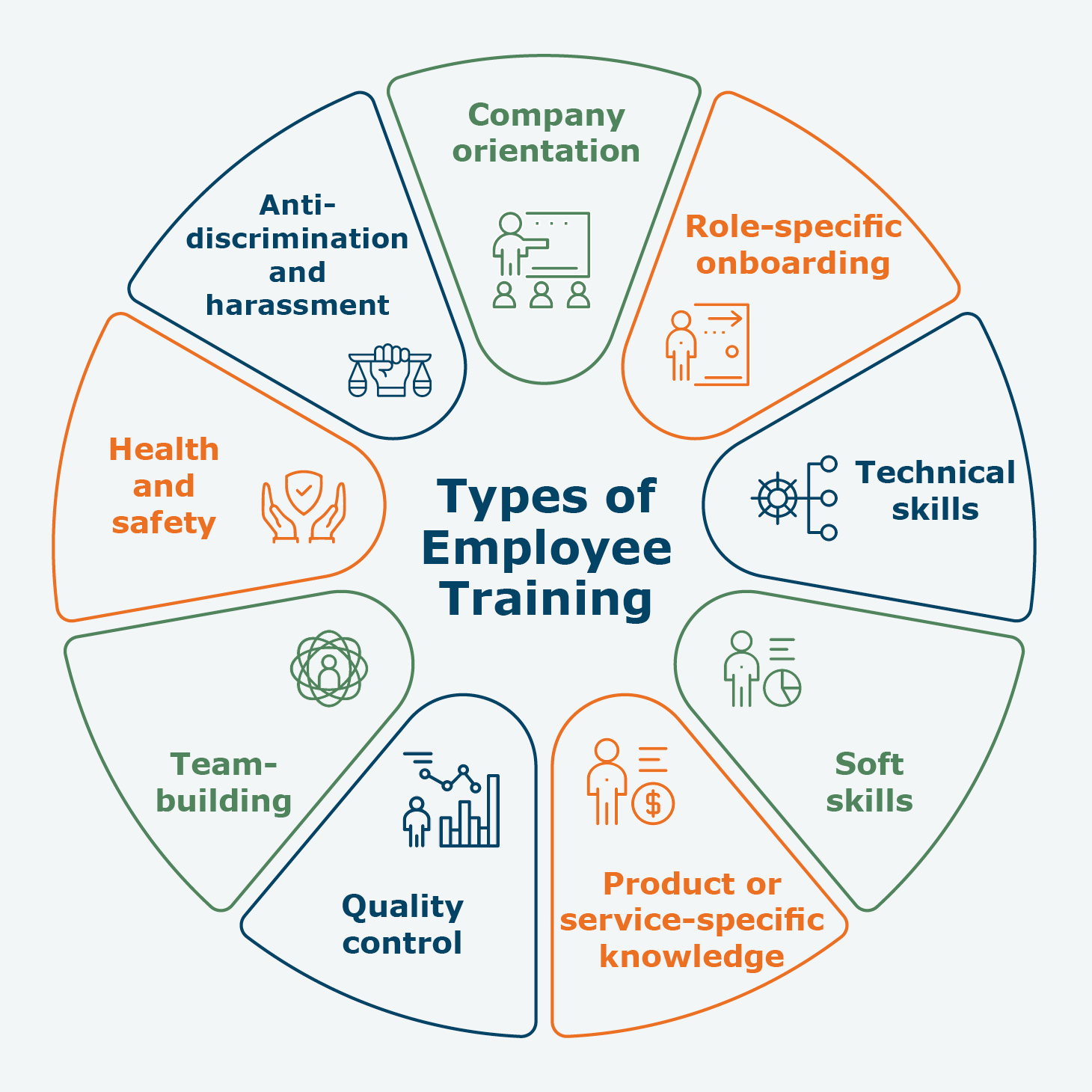
Company orientation
When first joining your organization, employees should receive a brief overview of your organization’s basics. This includes:
- What it’s like to work for your organization
- Your organization’s values
- Baseline work expectations
As new employees often have a lot to learn in their first few days, organizations should maintain related resources for reference. For example, all organizations should have an employee handbook that contains information on various roles’ basic responsibilities, time-off policies, company history, and more.
Role-specific onboarding
Onboarding or orientation is the basic training process for new hires. These training sessions should be designed to help employees familiarize themselves with the basics of your organization, particularly how to complete their standard daily responsibilities.
This process typically lasts between several weeks and several months, depending on the organization and complexity of the role.
Technical skills
Skills can generally be divided into two categories: hard skills and soft skills. Hard skills include specific abilities, such as knowledge of a certain programming language.
To help employees take on new responsibilities, expand their roles, or improve their overall workplace competencies, they may undertake technical skills training.
Soft skills
Soft skills are broader abilities that improve employees’ overall work performance, regardless of their specific responsibilities. These include skills such as:
- Communication
- Time management
- Leadership
- Conflict resolution
- Teamwork
- Project management
These skills can be difficult to practice directly when compared to technical and hard skills. Training sessions are designed to provide targeted tips and scenarios where employees can practice and build these nuanced skill sets.
Product or service-specific knowledge
Every organization is unique, and your employees will need to familiarize themselves with your specific products and services. This may involve walking employees through a demo of your software, taking nonprofit staff out to see program sites, or even having employees use a product themselves to see how it functions.
Through this training, employees will be better equipped to discuss, promote, and answer questions about your organization’s products and services. Additionally, with this knowledge, employees can offer targeted insights about how you can continue to improve your offerings.
Quality control
Employees should understand your organization’s quality standards and how to ensure your products and services meet them. Effective quality control training can improve the value of your organization’s offerings, improving customer satisfaction and brand integrity.
Team-building
Team-building training is designed to bring your staff together to develop personal relationships, better understand each other’s work and communication styles, and make your team a more cohesive unit overall.
Team-building training can include exercises specifically designed for team-building or activities that may not be directly related to work, such as a corporate volunteer day.
Health and safety
Health and safety standards are essential for minimizing any workplace hazards. Look up any specific regulations for your sector to ensure your training is legally compliant and follows industry standards.
Safety training usually includes:
- Steps to take to avoid potential accidents and harm
- What to do in the event of an incident to minimize harm
- Procedure for reporting workplace incidents
Anti-discrimination and harassment
Maintain a positive workplace where employees feel supported, engaged, and safe by implementing anti-discrimination and harassment policies and training that support them. These often include:
- A review of organizational expectations related to anti-harassment, maintaining a safe work environment, and reporting processes if an incident does occur
- Sensitivity training that teaches learners how to navigate potentially sensitive situations
- Bias training that teaches individuals how to monitor themselves for potential bias and work to minimize it
Some consultants, like ProspectHR, can provide custom anti-discrimination and anti-harassment programs to pull in each organization’s specific policies and create scenarios tailored to various industries.
State and federal law may also impose training requirements on employers and employees. For example, health and safety instruction is an ongoing necessity for some workplaces (e.g., hazardous material handling, food safety); some localities mandate sexual harassment and anti-discrimination training; and employees such as lawyers, accountants, and engineers who hold certain licenses may need to complete continuing education courses in order to maintain their good standing and practice in their fields.
Getting Started with Workplace Training: 4 Steps
1. Identify training needs.
Given the wide range of workplace training programs, you first need to determine what types of training your specific employees need.
Assess employees’ current performance to identify any gaps in your training process or common weaknesses. This allows you to create targeted training programs that are directly relevant to your employees’ day-to-day challenges.
You can identify training needs by:
- Surveying employees: Ask employees directly what challenges they experience or where they have noticed their fellow co-workers commonly fall short. For example, some employees may have doubts about their technical abilities, while others may feel that overall communication practices are lacking.
- Collaborating with managers across teams: Ensure you gain a variety of perspectives by seeking feedback from across your entire organization. Speak with managers from all of your departments to understand performance gaps in their own teams and identify overall trends. For example, you might learn that both your marketing and customer service teams struggle with your project management software, signaling a need for new technology training.
- Assessing work outcomes: Look at data related to product quality, resource management, customer satisfaction, and any other metrics relevant to your products or services. Identify areas where your team is falling short to consider types of training that could improve your organization as a whole.
2. Determine training model.
Decide what your workplace training will look like in practice. This includes:
- Format: How will training be conducted? Will it be just one workshop or a series of ongoing training sessions? Will your team conduct the training, or will you outsource it to a consultant? Decide how long training will take, who will oversee it, and what it should generally consist of.
- Delivery method: Determine if training will be conducted in-person, online, or through hybrid means. If you intend to have an online component, research educational platforms, such as learning management systems, online classes, and digital resources.
- Assessment: How will you evaluate if training was successful? Before training begins, select key metrics that you will use to assess employees. For example, you may look for an uptick in productivity or work quality, or you may jump straight to assigning employees new related responsibilities and seeing how they perform.
3. Create training materials.
Based on your goals, assemble training materials that align with your intended training pathway. You might create these materials yourself based on your specific work processes, buy training courses from third parties, or collaborate with a consultant to develop custom materials.
The best option for your organization depends on your goals and the intended type of training. For example, internal material development often makes the most sense for quality and product or service training. In contrast, you may need to outsource technical training so employees can earn a specific certification.
4. Track training outcomes.
In addition to your key metrics, stay open to employee feedback throughout the entire training process. To attain employee buy-in, training should be collaborative. Incorporating employee feedback helps you improve your overall training process and increase their commitment to the development process.
5+ Top Providers for Workplace Training Support
Although many human resources departments facilitate learning at their organizations using in-house trainers, there are times when it makes sense to rely on outside consultants for their expertise, well-vetted programs, and accessibility. In addition, many of these programs are virtual and self-paced.
In this section, we outline a few top providers who offer support in various areas related to workplace training. These options focus on professional development initiatives, team-based training, or providing platforms for delivering workplace training materials. These consulting firms may not serve as a substitute for training resources or requirements dictated by industry-specific regulatory or licensing bodies, so every organization must take the necessary steps to ensure compliance.

ProspectHR Consulting – Top Workplace Training Provider for Custom HR Support
ProspectHR Consulting provides broad-based HR support to small and midsize organizations include training programs. We take a customized approach to each client’s needs and support an organization’s initiatives on a project or ongoing basis. Our workplace training offerings include Anti-Harassment for Employees and Supervisors, Building a Culture of Diversity, Equity and Inclusion, and Management and Leadership Training.

AllenComm – Top Workplace Training for Sector-Specific Regulatory Compliance
AllenComm assists companies and their employees in achieving business objectives while meeting applicable legal requirements. They offer compliance training for the following industries: government and other public entities, finance, healthcare, consumer goods, retail, and manufacturing. With a proven track record and deep understanding of these industries, they are a top choice for specialized compliance needs.

Web CourseWorks – Top Learning Management System (LMS)
Web CourseWorks is a leading provider of Learning Management Systems (LMS) and eLearning for associations, nonprofits, and other public bodies. They customize each learning platform to meet an individual organization’s unique technology and educational needs. Consulting support from design through utilization of the system is also available, ensuring long-term value and adoption.

Artisan eLearning – Top Custom eLearning Development
Artisan eLearning helps organizations develop their online learning environment and drive stronger employee engagement. They can transform current training materials into web-based modules or build an online training program from scratch. By matching their know-how with your subject matter experts, Artisan provides a unique training solution for each client.
Skillsoft – Top Technology Training Resources
Skillsoft is a leading digital learning provider. They offer a full complement of eLearning support from LMS to online training content. One of their focus areas is managing the technology gap. Skillsoft products and services enable employees to stay up to speed with ever-changing technological advancements, thereby helping businesses stay competitive.
National Safety Council – Top Workplace Training Provider for Safety Compliance
The National Safety Council (NSC) is a nonprofit safety advocate focused on creating safe work cultures. Their offerings go beyond OSHA compliance, educating participants in best practices from across the globe. To build a culture focused on workplace safety, the NSC offers customized and off-the-shelf training packages. Depending on the course, NSC can impart the information in-person or online.
Wrapping Up
Workplace training is important in building individual skills, strengthening teamwork, developing talent, and positively impacting your bottom line. Whether you choose to use in-house staff, outsource to training experts, or a combination of both, will depend on your internal capability, budget, and the organization’s distinct objectives.
Partnering with external training consultants can have a great impact on your organization, allowing you to take advantage of their deep expertise and up-to-date offerings. It allows your staff to focus on their core functions and strengths. The HR professionals at ProspectHR welcome the opportunity to explore your training needs with you.
To learn how ProspectHR can help your organization beyond workplace training, keep exploring with these resources:
- HR Assessments: Comprehensive Overview & 15 Key Questions
- Performance Reviews: Overview & Tips from HR Experts
- Employee Coaching: Complete Overview and How-To Guide
ProspectHR Consulting provides a complete range of internal training resources and services.
Want to learn more?