
PEO vs Payroll Software
How to Choose the Right HR System for Growth and Scale
If you run or manage a mission-driven organization or small business, you’ve probably felt the tension: HR is getting more complex, but you don’t have a full HR team to manage it. So where do you start?
In our recent webinar From Payroll to People: Aligning HR Systems with Mission and Growth, ProspectHR Consulting partnered with Justworks to walk nonprofit leaders and small business owners through one of the most important decisions they’ll face: choosing the right HR solution for where they are today and where they’re headed.
The conversation covered everything from how to assess your current HR needs to understanding the difference between a Professional Employer Organization (PEO) and a payroll-first tool, and when each one makes sense.
Here’s what you need to know.
First: Understand What Problem You’re Actually Trying to Solve
Most organizations don’t go looking for “HR software.” They go looking for relief from manual payroll, from compliance uncertainty, or from doing everything in spreadsheets.
Before comparing any tools or platforms, get clear on what’s breaking down in your HR operations today.
Common HR Pain Points for Mission-Driven Organizations
- Payroll is manual, error-prone, or taking too much time
- You’re unsure whether you’re compliant with federal, state, or local employment laws
- Onboarding new hires is inconsistent or entirely paper-based
- Benefits are hard to administer or not competitive enough to attract talent
- You have no centralized place to store employee records or documents
- HR tasks keep falling to someone who wasn’t hired to do them
Your answers here will shape which type of HR solution actually fits, because not every problem needs the same tool.
💡 Not sure what’s holding your HR back?
ProspectHR Consulting helps mission-driven organizations identify their HR gaps before recommending any technology. Start with a clear picture of where you are.
Know Your Options: PEO vs. Payroll-First Tools
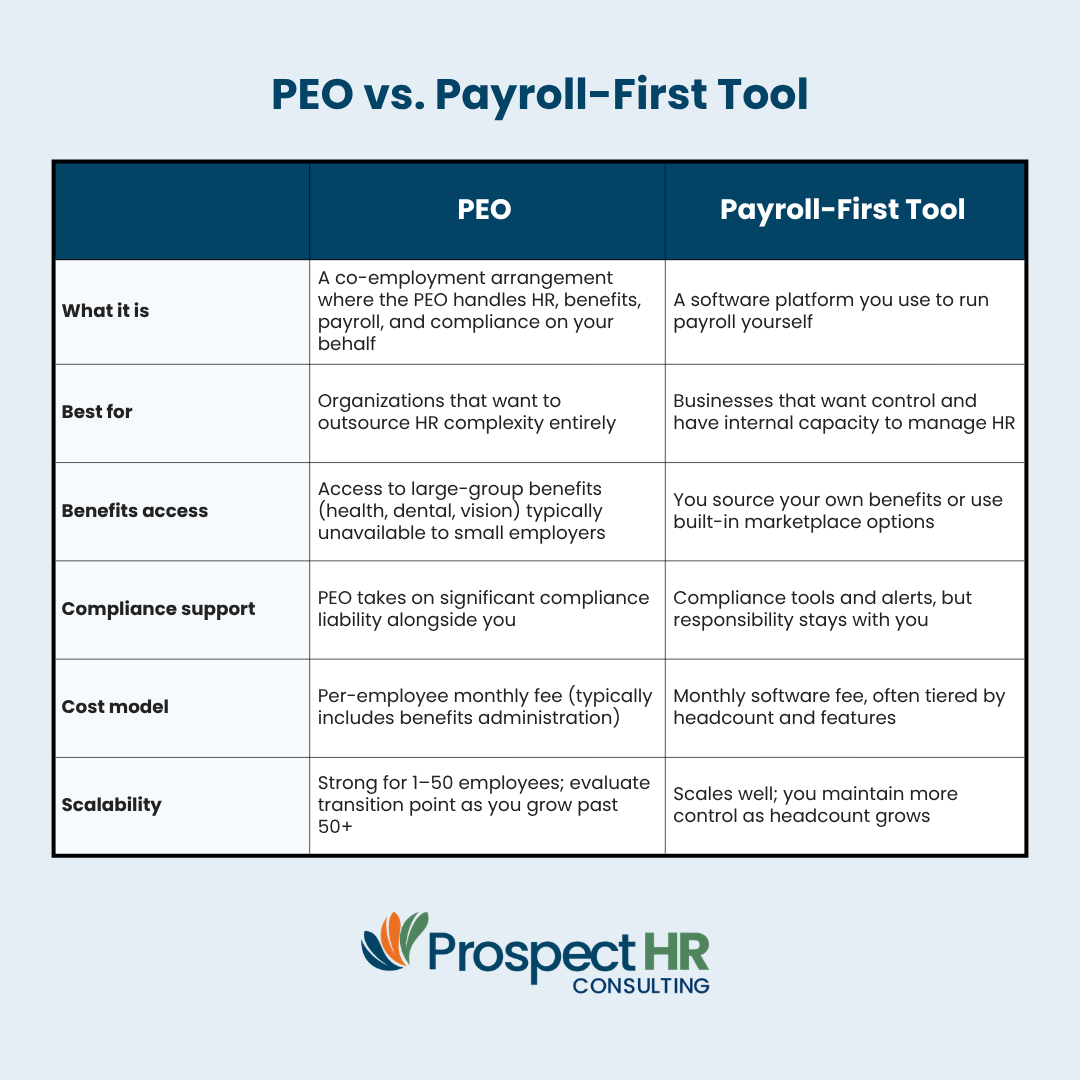
During the webinar, we focused on two primary categories of HR solutions that make the most sense for mission-driven organizations, each with a different model.
When a PEO Makes Sense
A Professional Employer Organization (PEO) enters into a co-employment relationship with your business. In practical terms, this means the PEO becomes the employer of record for administrative purposes such as, handling payroll, benefits, workers’ compensation, and compliance, while you retain full control over your team’s day-to-day work.
Signs a PEO May Be the Right Fit
-
- You have fewer than 50 employees and want access to Fortune 500-level benefits
- Compliance (ACA, FMLA, state-specific laws) feels like a constant source of anxiety
- You operate in multiple states or have remote employees
- You’re spending significant time on payroll and benefits administration
- You want to reduce your HR liability exposure as you grow
✅ What we heard from mission-driven leaders in the webinar:
Many attendees were surprised to learn they could offer competitive health benefits through a PEO at a cost comparable to what they would pay if they sourced coverage independently. For businesses competing with larger employers for talent, this was a significant consideration.
✅ Fun Fact:
Did you know that you can often bring your own benefits and workers’ compensation coverage to a PEO?
When Payroll-First Software Makes More Sense
Payroll-first platforms put HR tools in your hands. You run payroll, manage onboarding, track time off, and handle compliance, supported by the software, but with your team in the driver’s seat.
These tools work well for organizations that want software infrastructure without entering a co-employment arrangement.
Signs a Payroll-First Tool May Be the Right Fit
- You operate in a single state and do not have remote employees
- You already have a benefits broker or don’t need to change your current coverage
- You’re in an industry or state where co-employment arrangements are complicated
- You’re building toward an internal HR function and want a platform that grows with it
Key Questions to Ask Before You Decide
Do you want to outsource HR or manage it internally?
PEOs are built for outsourcing. Payroll tools are built for self-management. Be honest about your team’s capacity.
How important are benefits competitiveness to your hiring?
If you’re losing candidates to larger companies on benefits, a PEO’s group buying power can provide a strategic advantage. On the flip side, it’s important to be realistic about the benefits that your organization can afford.
What’s your risk tolerance for compliance?
A PEO takes on shared compliance responsibility. With payroll software, that liability sits with you.
How fast are you growing?
If you’re planning to scale significantly, understand the transition point. Many businesses move off PEOs as they build internal HR capacity.
What’s your actual budget?
PEO fees are often per-employee-per-month and inclusive. Payroll software can be lower cost but may require add-ons for full functionality.
Don’t Skip the Implementation Step
One thing that came up repeatedly in the webinar: many organizations underestimate how much work it takes to get a new HR system running properly, regardless of what they choose.
Whether you’re onboarding with a PEO or standing up a payroll tool, the transition requires real attention.
What to Plan For During Implementation
- Auditing and cleaning up your existing employee data before migration
- Updating or creating offer letters, handbooks, and HR policies
- Training whoever will own the system day-to-day
- Communicating the change to employees clearly and early
- Setting up integrations with your accounting or other software
- Testing bank connections before the first payroll is scheduled to process
⚠️ A common mistake we see:
Organizations often choose a platform, then expect it to “just work” from day one. The businesses that get the most value from any HR solution, PEO or otherwise, are the ones that invest a few weeks in setup, data hygiene, and team training upfront.
Simplicity Is the Goal, Not Sophistication
One of the most consistent themes throughout our webinar was this: sometimes simplicity is strategic. You don’t need the most feature-rich HR platform available; you need the one that solves your specific problems without adding new complexity.
A 10-person nonprofit that’s drowning in payroll admin and benefits questions is probably better served by a PEO than by a sophisticated system with dozens of modules they’ll never use.
A 100-person business with an HR department and established benefits may achieve greater flexibility and cost efficiency with a well-implemented payroll platform.
The right HR solution is the one that makes HR work better for your specific situation, not the one with the longest feature list.
How ProspectHR Consulting Helps You Choose
At ProspectHR Consulting, we work with small and mid-size organizations to help them make confident, strategic HR decisions, including choosing the technology and service model that’s right for them.
Our approach to HR solution selection includes:
- HR Assessment: We document your current HR operations, identify what’s working and what’s not, and define the requirements any solution needs to meet.
- Solution Analysis: We help you evaluate what makes the most sense for your organization, based on your size, industry, budget, and growth plans.
- Vendor Evaluation Support: We provide guidance on comparing platforms so you can choose based on fit, not on sales pressure.
- Implementation Readiness: We help you prepare your data, policies, and team for a smooth transition, so you get value from day one.
Not Sure Which HR Solution Is Right for Your Business?
We help mission-driven organizations cut through the noise and choose the HR solution that actually fits, whether that’s a PEO, a payroll platform, or something else entirely.
Final Thoughts
There’s no universal answer to the ‘which HR solution is the best for my organization’. But there is a right process for making the decision, and it starts with understanding your own operations before you ever open a vendor’s website.
Regardless of the solution, the goal is the same: an HR foundation that reduces your administrative burden, keeps you compliant, and lets you focus on growing your mission.
When HR is working the way it should, you stop thinking about it, and that’s exactly where you want to be.